
 English
 English
 عربى
 한국어

Industrial Wall Mounted Oscillating Fan
The Industrial Wall Mounted Oscillating Fan is a versatile and efficient cooling...
 Add: Plot 23, Huanglang Industrial Zone, Jinqing Town, Luqiao District, Taizhou City, Zhejiang Province
 TEL: +86-13586083215
In large warehouses and manufacturing facilities, uncomfortable working conditions are not always caused by high indoor temperatures alone. Hot air can accumulate near the ceiling, while areas around production lines, storage racks, and loading zones may experience uneven air movement. Simply installing more small fans does not necessarily solve these problems. For facility managers and equipment buyers evaluating an Industrial Ceiling Fans Factory, the key question is how to create effective airflow across occupied areas while considering building layout, energy use, and operating requirements. A well-planned industrial fan system can support workplace comfort and complement existing HVAC equipment.
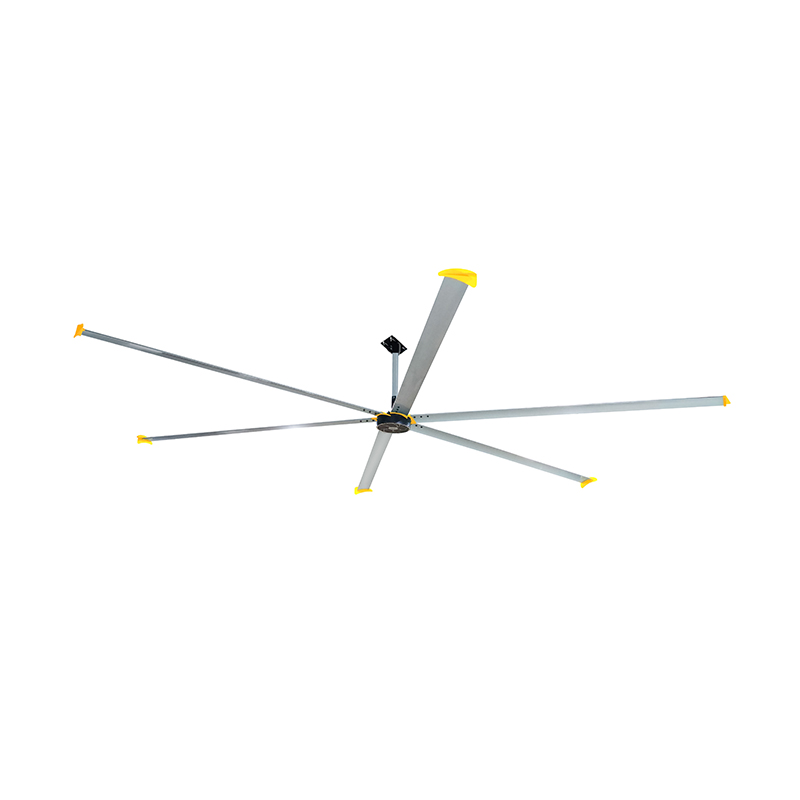
High ceilings create conditions in which warm air can accumulate in upper areas, particularly when heating systems or industrial equipment generate heat. At floor level, employees may still experience uncomfortable conditions, even when the building's average temperature appears acceptable.
This temperature difference, often called thermal stratification, can make climate control less efficient. In facilities with long operating hours, the problem may become more noticeable during seasonal temperature changes.
Industrial ceiling fans, especially high-volume, low-speed (HVLS) models, help circulate air between ceiling and occupied areas. Their purpose is to improve air distribution rather than independently lower the actual air temperature.
A large fan does not automatically provide suitable airflow throughout an entire facility. Its effectiveness depends on installation height, blade design, surrounding structures, and the location of workers and equipment.
Before selecting a model, buyers should review the building layout and identify areas that require better air movement, such as:
Mapping these areas helps engineers determine fan quantity and placement based on actual operating conditions rather than relying on diameter alone.
Heat exposure is an increasing concern for warehouse operators and manufacturing employers, particularly in facilities with limited air conditioning or substantial internal heat sources. Air movement can help employees feel cooler by supporting the evaporation of perspiration, although it does not reduce the surrounding air temperature.
For this reason, industrial fans should be considered as part of a broader heat-management plan. Buyers may need to evaluate ventilation, hydration arrangements, work schedules, and temperature monitoring alongside air circulation equipment.
A practical solution begins with understanding where heat accumulates and which occupied zones need additional airflow.
Industrial ceiling fans do not need to replace an existing heating or cooling system to provide value. They can complement HVAC equipment by helping distribute conditioned air more evenly throughout a large indoor space.
During cooling periods, improved air movement can support perceived comfort in occupied zones. In colder seasons, circulation can help redistribute warmer air that collects near the ceiling.
However, circulation and ventilation perform different functions. Ceiling fans move indoor air, while a ventilation system supplies outdoor air or removes indoor air through designed intake and exhaust routes. Facilities handling dust, chemical fumes, or vehicle exhaust still require appropriate ventilation and source-control measures.
Installation planning is essential for both operating performance and workplace safety. The building structure must be suitable for supporting the fan and its operating forces, while the rotating blades need sufficient clearance from surrounding objects.
Engineers should check:
These details should be confirmed before installation to avoid costly adjustments later.
For facilities operating fans over long shifts, motor efficiency and speed adjustment deserve careful consideration. Different areas may require different airflow levels depending on occupancy, equipment operation, and seasonal conditions.
Variable-speed controls allow operators to adjust fan operation instead of relying on a fixed setting throughout the day. Buyers should also compare motor specifications, noise levels, maintenance requirements, and control compatibility when reviewing different suppliers.
A suitable configuration should match the facility's operating pattern rather than simply offer the largest available output.
Choosing industrial ceiling fans involves more than comparing product dimensions and prices. Building conditions, airflow coverage, installation safety, energy management, and maintenance all influence long-term suitability.
As a manufacturer, Taizhou Jiucang Electromechanical Co., Ltd. understands the importance of matching equipment selection with practical application requirements. Buyers searching for an Industrial Ceiling Fans Factory should communicate their facility layout and operating conditions clearly, making it easier to evaluate suitable fan configurations and develop an effective air circulation plan.


 Add: Plot 23, Huanglang Industrial Zone, Jinqing Town, Luqiao District, Taizhou City, Zhejiang Province
 Email: 39489814@qq.com
 Phone: +86-13586083215
Guided by our vision to "become the benchmark industrial fan creator and manufacturer," we have consistently innovated and advanced to establish our current industry leadership position.
Copyright © Taizhou Jiucang Electromechanical Co., Ltd.
All Rights Reserved.

China Large Silent Fans
